From the Mile High Club and prom-night limousine rituals to Risky Business and Pornhub amateur content, mobility has never been just about getting from A to B. Across air travel, public transport, and private vehicles, transport spaces have repeatedly been represented and appropriated as spaces of intimacy, experimentation, and sexual expression.
This is particularly concerning in relation to public and shared automated vehicles (AVs), where enclosure, shared use, and the absence of an authority figure can warp perceptions of accountability and intervention potential, with important consequences for passenger comfort, perceived safety, and public acceptance of the technology.
Media Coverage
Robotaxis haben ein Sex-Problem – die Lösung ist durchsichtig, blue News.
Robotaxi, il problema che non ti aspetti: la gente ci fa le cosacce, Futuro Prossimo.
Fahrgäste haben immer öfter Sex in Robotaxis – Forscher halten jetzt dagegen, Der Standard.
Kialakítható-e olyan autonóm taxi, amiben a tartalomkészítők nem fognak szexelni?, Sg.hu.
У Швеції обговорили дизайн роботаксі для протидії інтимній поведінці, Процес.
Can good design stop content creators from having sex in robotaxis?, Ars Technica.
Academics want driverless taxis redesigned to put you off having sex in them, SEXTECHGUIDE.
Dilemmat: Hur stoppar man sexet i taxibilarna?, Svenska Dagbladet.
Olá robotáxis. O sexo em transportes públicos subiu de nível, ZAP.aeiou.
Akademikernas udda dilemma – hur man hindrar folk från att ha sex i robottaxis, BREAKIT.
Σεξ μέσα σε robotaxi; Ακαδημαϊκή μελέτη για την οικειότητα στα αυτόνομα οχήματα, techgear.gr.
Driverless taxi passengers face bans for having sex, The Times.
Meet the Academics Trying to Stop You From Having Sex in Robotaxis, WIRED.
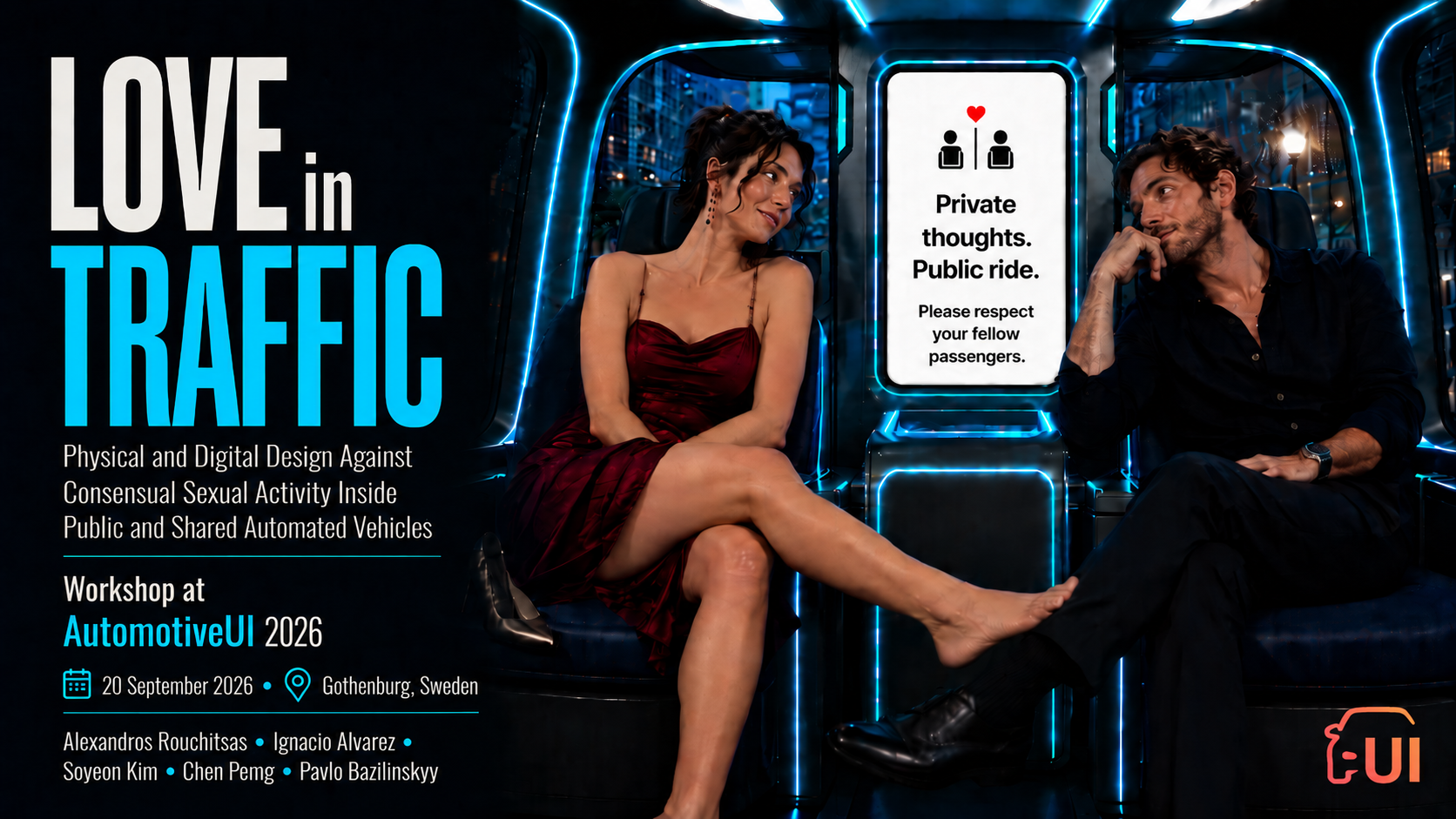
Our workshop, Love In Traffic: Physical and Digital Design Against Consensual Sexual Activity Inside Public and Shared Automated Vehicles, approaches consensual sexual activity inside public and shared AVs as a design stress test for how they are perceived and used as collective spaces, and explores how physical and digital design can discourage sexual activity in these environments. We aim to synthesize design principles, identify open research questions, and establish a research agenda for designing public and shared AVs as comfortable and respectful collective spaces. The full paper is available here.
Content notice: Please note that this workshop includes discussion of consensual sexual activity, sexually explicit media, and related scenarios in public and shared transport. Some participants may find this content sensitive, uncomfortable, or distressing. Participation is voluntary, and attendees should use their own discretion in deciding whether the workshop is appropriate for them before enrolling.
Following ethical approval (ERB-1646, Ethical Review Board of Eindhoven University of Technology), we intend to process output generated during the workshop in future academic publications, with participants’ informed consent.
Schedule and Activities
The workshop (W1) will take place on 20 September 2026, 08:30–12:30 in room 2124 (Jämvikten), at Natrium, Gothenburg University. See full AutoUI programme here.
| Activity | Time | Description |
|---|---|---|
| Welcome, Scope, and Framing |
08:30–08:45 |
Introductory talk to welcome participants, clarify workshop scope, distinguish consensual sexual behavior from criminal conduct, and frame HF/UX concerns. |
| Scene-Setting | 08:45–09:30 | Lightning talks to establish shared grounding on sexual behavior, safety, affordances, media representations, responsibility, and bystander dynamics. |
| Group Activity 1: Empathizing | 09:30–10:15 | Participants explore assigned scenarios from a bystander perspective and capture the experience in detailed journey maps. |
| Coffee Break | 10:15–10:45 | |
| Group Activity 2: Conceptualizing | 10:45–11:30 | Participants conceptualize physical and digital interventions informed by their journey maps and document the resulting concepts in detailed design briefs. |
| Coffee Break | 11:30–11:45 | |
| Group Activity 3: Visualizing | 11:45–12:15 | Participants translate their design briefs into prompts to produce AI-generated images of their interventions. |
| Synthesis and Wrap-up | 12:15–12:30 | Participants derive design recommendations and research priorities from workshop outputs. |
Speakers
Scott Cohen
University Of Surrey, Guildford, United Kingdom
Scott Cohen is a Professor of Tourism and Mobility with over 20 years of academic experience. He is Invited Full Professor at the University of Algarve (Portugal) and Guest Professor of Tourism at Linnaeus University (Sweden). Scott’s research is primarily focused on societal issues in the contexts of travel, mobility and transport, with particular interests in hypermobility, sustainable mobility, autonomous vehicles and in business and lifestyle travel. Scott’s research has been featured in prominent media outlets such as The Economist, The Washington Post, NBC News, Fast Company, Newsweek, USA Today, The Financial Times and The Telegraph.
Oscar Oviedo-Trespalacios

Delft University of Technology, Delft, The Netherlands
Oscar Oviedo-Trespalacios is an Associate Professor of Safety in Intelligent Sociotechnical Systems at Delft University of Technology. Oscar’s areas of expertise include human factors engineering, sustainable development, misuse of technology, digital work, and transport safety and security. His research has been widely reported in international media, including the ABC, the New York Times, the Independent, the Men’s Health Magazine, and the Washington Post.
Organizers
Alexandros Rouchitsas
KTG Research & Innovation Ltd., Famagusta, Cyprus (a.rouchitsas@ktg-research.eu, alexandros.rouchitsas@gmail.com)
Alexandros Rouchitsas is the lead researcher and media contact for the Love In Traffic project. He is a HF/UX professional and certified ergonomist (Eur.Erg.). His research interests include human–AI symbiosis, human–robot collaboration, automated driving, and eye tracking. Alexandros received his PhD from Luleå University of Technology in human factors of automated driving. Currently, he is with KTG Research & Innovation Ltd. as a Senior Research Fellow.
Ignacio Alvarez

Technische Hochschule Ingolstadt, Ingostadt, Germany
Ignacio Alvarez holds the Bavarian Top Professorship for Human-Centered Intelligent Systems at Technische Hochschule Ingolstadt. His research interests are at the intersection of agentic AI, systems engineering and human computer interaction. He received his PhD at Basque Country University and Clemson University in developing in-cabin assistant systems.
Soyeon Kim
University of Warwick, Coventry, United Kingdom
Soyeon Kim is an assistant professor at University of Warwick. Her research focuses on understanding human behaviour and designing human-machine interaction in automated vehicles. She holds a PhD at TU Delft in designing in-vehicle HMI for trustworthy automated vehicles.
Chen Peng

Loughborough University, Loughborough, United Kingdom
Chen Peng is a Lecturer (Assistant Professor) at Loughborough University, UK. Her research focuses on human factors in future mobility. She received her PhD from University of Leeds, UK, as a Marie Sklodowska-Curie Fellow.
Pavlo Bazilinskyy
Eindhoven University of Technology, Eindhoven, The Netherlands
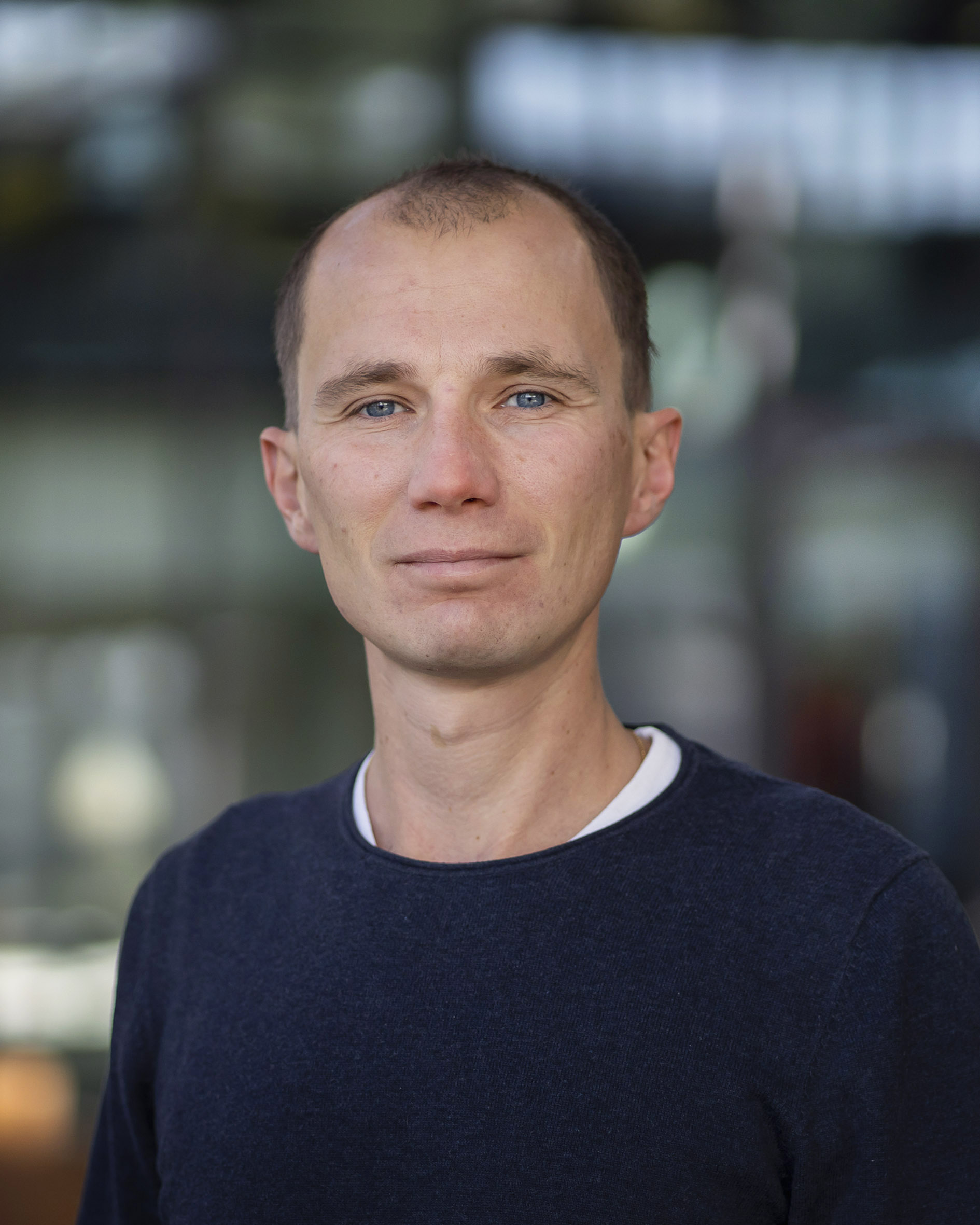
Pavlo Bazilinskyy is an assistant professor at TU Eindhoven focusing on AI-driven interaction between automated vehicles and other road users. He finished his PhD at TU Delft in auditory feedback for automated driving as a Marie Curie Fellow, where he also worked as a postdoc.